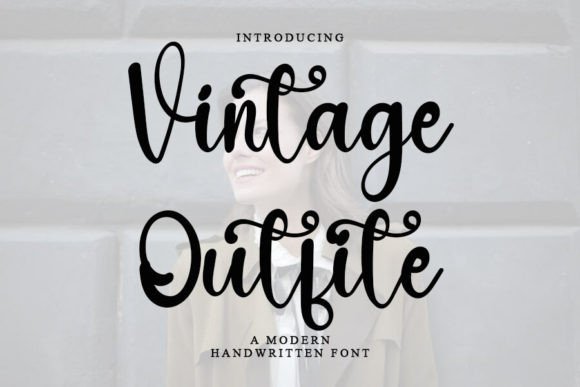
Vintage Outfit: A Timeless Script Font for Small Business Branding
As a small business owner who’s designed everything from candle labels to café menus, I know how much weight a single font carries in shaping how customers perceive your brand. Vintage Outfit isn’t just another handwritten font—it’s a thoughtful, elegant script typeface that brings warmth, authenticity, and quiet confidence to every touchpoint. Whether you’re launching a new product line or refreshing your packaging, this Script Amp font helps your business look intentional—not improvised.
Vintage Outfit has a soft, flowing rhythm with delicate swashes and balanced letterforms. It’s not overly ornate, nor is it stiff or generic. Think of it as the kind of handwriting you’d see on a hand-calligraphed wedding invitation—refined but approachable, classic but never dated. Its personality leans toward artisanal, heartfelt, and quietly sophisticated—ideal for brands rooted in craft, care, and personal connection.
In practice, Vintage Outfit shines where first impressions matter most. Use it for your logo or primary brand mark if your business thrives on charm and character—like a boutique selling handmade ceramics, a wellness coach building trust through gentle authority, or a local bakery whose sourdough loaves come wrapped in kraft paper and twine. On product labels, it adds distinction without sacrificing legibility at small sizes (test it at 10–12 pt on a 2 oz candle jar—it holds up well). For thank-you cards or packaging tape stamps, its elegance reinforces sincerity without feeling pretentious.
On your website, Vintage Outfit works best as a display font—not body text. Try it for hero banners, section headers, or call-to-action buttons where you want emotional resonance. Pair it with a clean sans serif like Montserrat or Inter for body copy, navigation, and forms. That contrast creates visual hierarchy while keeping content scannable on mobile. In social media graphics, it elevates Instagram story text overlays or Pinterest quote pins—especially when layered over natural textures like linen, marble, or watercolor backgrounds. Its subtle irregularity makes digital posts feel human, not algorithmic.
Real-world consistency matters more than design theory. When I switched my client coaching business to Vintage Outfit for all headline materials—website banners, email subject lines, workshop PDF covers—I noticed customers started referencing “that beautiful script” unprompted. It became part of our visual shorthand. The same happened with a friend’s botanical skincare line: using Vintage Outfit across her serum bottle label, Instagram highlights, and seasonal promo flyer made her brand feel cohesive—even though she was designing most assets herself in Canva.
That said, don’t assume it fits every use case. Vintage Outfit isn’t built for dense paragraphs, tiny QR code footers, or high-contrast outdoor signage. Its strength lies in moments of emphasis: a café menu’s daily special, a sticker on a subscription box, the “Hand-poured in Portland” line on a soy wax candle. For anything requiring extended reading or strict accessibility compliance, pair it thoughtfully with a highly legible supporting font—and always preview how it renders on actual devices before finalizing.
Before committing across your entire brand, test Vintage Outfit in three places: your most-used digital template (e.g., Canva social post), your most common printed item (e.g., business card or hang tag), and one customer-facing physical touchpoint (e.g., receipt stamp or loyalty card). Adjust tracking and size as needed—tightening letter spacing slightly often improves cohesion in logos, while opening it up helps readability in longer display lines.
Font pairing is simpler than it sounds. Vintage Outfit pairs naturally with neutral, grounded typefaces. Try it with a warm serif like Lora for editorial-style blog headers or a friendly sans like Poppins for clean, modern contrast. Avoid competing scripts or overly decorative fonts—they’ll muddy your message. Stick to one strong accent font (Vintage Outfit) and one reliable workhorse (your sans or serif companion). That balance supports clarity, builds recognition, and scales gracefully as your business grows.
Licensing is non-negotiable. Vintage Outfit is a premium font from the Script Amp category, and its commercial license covers use in logos, packaging, social media, websites, and client projects—as long as you’ve purchased the appropriate tier. If you’re selling digital templates, printables, or merchandise featuring the font, double-check the license terms. Using unlicensed fonts risks takedowns, legal notices, or rebranding delays—neither of which help a small business stay agile.
What sets Vintage Outfit apart isn’t just its beauty—it’s how reliably it translates intention into impression. When your handmade soap label shares the same graceful curve as your Instagram bio and your website’s “About” headline, customers subconsciously register consistency. That consistency builds familiarity. Familiarity builds trust. And trust? That’s what turns first-time buyers into repeat customers and word-of-mouth advocates.
If your current branding feels scattered—or worse, forgettable—start small. Swap out one headline font for Vintage Outfit in your next email campaign or product launch graphic. See how it changes the tone. Then build outward: apply it to your next batch of packaging, update your Canva brand kit, refine your logo lockup. Let the font do quiet, confident work—so you can focus on what really moves your business forward.