Overstay Handwritten Font for Professional Branding
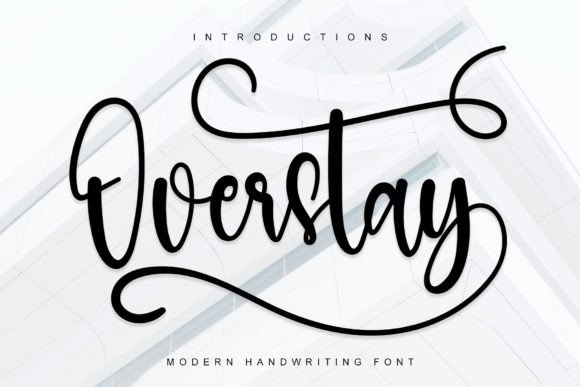
As a small business owner who’s designed everything from coffee bag labels to Instagram story templates, I know how much a single font can shape how customers perceive my brand. That’s why I was immediately drawn to Overstay—a stylish handwritten font with a contemporary atmosphere and impeccable form, inspired by timeless classic calligraphy. It’s not just decorative; it’s balanced, varied, and built to carry real business weight.
Overstay lives in the Script Amp category of fonts, meaning it’s expressive and intentional—not a casual scribble, but a refined script that feels personal without sacrificing polish. Its letterforms have gentle contrast, natural rhythm, and subtle variation in stroke weight, giving it warmth and authenticity. Whether you're launching a handmade soap line or rebranding your wellness coaching practice, Overstay adds quiet confidence to every touchpoint.
I’ve used Overstay across five key areas—and each time, it strengthened consistency and clarity: packaging design, product labels, social media graphics, website banners, and printed collateral like thank-you cards and menus. For example, a local candle maker paired Overstay with a clean sans serif for her jar labels—her logo in Overstay, ingredient list in Montserrat. The result? Instant recognition on crowded shelves and cohesive posts across Pinterest and Instagram.
It works especially well as a display font or accent font. Think: your shop name on a café menu, the headline on a limited-edition product launch flyer, or the “Thank You” line on a branded sticker. Because Overstay is designed with legibility in mind—even at smaller sizes—it holds up beautifully on 2-inch product tags and mobile-optimized social thumbnails. That said, I don’t use it for long paragraphs or fine print. It’s not a body font, and it shouldn’t be. Its strength lies in moments of emphasis, not endurance.
For branding to feel trustworthy, it needs repetition and restraint. Overstay supports that. When I tested it across three months of customer-facing materials—email headers, packaging tape seals, and even embroidered tote bags—I noticed people started recognizing our visual tone before they saw our logo. That’s the power of a consistent, intentional script font: it becomes part of your brand’s voice.
Real-world readability matters. I printed Overstay at 10 pt on matte kraft paper (for tea box labels) and at 36 pt on glossy postcards (for seasonal promotions). In both cases, the letterforms remained distinct and graceful—no blurring, no awkward joins. On screens, it renders cleanly in modern browsers and design tools like Canva, Adobe Express, and Figma. Just avoid ultra-thin weights for small text or low-resolution exports.
Font pairing is where Overstay really shines. As a script font, it pairs naturally with strong, neutral companions. My go-to combo is Overstay + Inter (a free, highly readable sans serif) for digital use—or Overstay + Lora (a warm, contemporary serif) for print-heavy brands like bookish boutiques or artisan stationery shops. The contrast does the work: Overstay brings personality; the supporting typeface delivers clarity. No need to overcomplicate it. One expressive font, one functional font—that’s enough for 95% of small business needs.
If you’re building a new brand identity or refreshing an existing one, test Overstay in context before committing. Try it on a mockup of your most-used asset: maybe your Shopify product page header, your Etsy listing banner, or your Instagram highlight cover. See how it sits next to your photography, your color palette, and your actual product. Does it feel like *you*—but elevated? If yes, it’s likely the right fit. Don’t choose a font because it’s trendy. Choose it because it makes your message easier to trust, remember, and share.
Licensing is non-negotiable. Overstay is a commercial font, and Script Amp clearly outlines usage rights. Before adding it to product packaging, digital templates, client deliverables, or merchandise, confirm your license covers those uses. Most standard licenses include web embedding, desktop use, and basic print—but extended rights are needed for resaleable design assets or physical goods with embedded typography. A quick check saves time, money, and legal risk down the line.
I’ve seen small businesses use Overstay to unify wildly different offerings: a ceramicist’s online shop and studio signage, a nutritionist’s PDF guides and workshop slides, a boutique’s hang tags and email subject lines. In each case, the font didn’t distract—it anchored. It made handmade feel intentional, services feel human, and digital content feel grounded. That’s rare. Most expressive fonts tip into “cute” or “fussy.” Overstay stays centered: elegant but approachable, distinctive but dependable.
When your brand appears across so many places—on a sticker slapped on a takeout bag, in a tiny Instagram bio, on a hand-stamped gift tag—you need a typeface that adapts without losing its soul. Overstay does that. It’s not flashy, but it’s memorable. Not loud, but it commands attention where it counts. And for small business owners juggling design, fulfillment, and customer service? That kind of quiet reliability isn’t just nice—it’s necessary.